Asteroid City Review
Maybe I think my best friend Christian would’ve loved Wes Anderson’s Asteroid City. Maybe I think not as much as I do.
I saw Anderson’s latest movie with my aunt and uncle at a theater in West Denver on Thursday night. In other words, as soon as I could. The opening credits began in succession with a grin growing across my face. Wes Anderson is my favorite director. I don’t think the smile left until I said goodbye to them and walked to my car to drive home. Welling eyes accompanied the grin once “ASTEROID CITY” appeared on the screen above a tumbling train heading across a desert scene. Nearly the same thing happened two days later when I watched the movie again (as one does)—this time, by myself. I’m not really sure why I teared up both times. All I know is that it has been happening a lot recently.
I lost my best friend three months ago. A lot of other people lost him as well. I don’t know where he went or if he went anywhere at all. Augie Steenbeck lost his wife three weeks ago. Her four kids and her dad lost her as well. He used to think she’s just dust in a tupperware container (a third of her at least). Now, he thinks she might be in the stars.
Augie, like myself, is a procrastinator. Jones Hall is the actor who plays him in the play. In the movie about the play, Jason Schwartzman plays them both. I think they all, including me, want to know why Augie burns his hand on the griddle. Only on a second viewing did I fully notice the repetition of that line, among many others. Anderson even spoils the biggest scene in the movie (in my opinion) in the first act. But when that scene does happen later on, it does so even more indirectly, with the actress who played Augie’s wife (Robbie) simply reading their entire scene line by line to a silent Hall (Schwartzman), similarly to in Charlie Kaufman’s 2008 directorial debut, Synecdoche, New York (another great, sadder movie).
Each choice that Anderson makes, as convoluted as it may be, means something. This has been true for over two decades now, with the intentionality and the convolution both increasing with each release. Coming into the spotlight most notably with his 2014 spectacle, The Grand Budapest Hotel, Anderson is the most recognizable contemporary director in terms of the way his movies look. His style, symmetry, and idiosyncrasies inspire, annoy, or entertain audiences. It bores some of them, too.
A lot of discussion has surfaced around this topic in the past year or so, and I don’t want to exhaust it too much. But A.I. and online content creation play a large part in how I interpret Anderson’s work, especially Asteroid City. Art, in my eyes, is never a fully actualized entity. You can make your art with every intention and action geared towards an end product that is intensely vulnerable and painstakingly truthful, but I don’t know if anyone can ever go the distance with it. There is always something holding it back, whether it be the medium, skill level, capitalistic motives, or something else.
I think movies might be the biggest hindrance of expression in the artistic realm. It’s the only art form to combine basically every single other art form in one way or another. It’s arguably the most expensive art to create. And it often takes an extensive amount of technical, non-creative work. I think Wes Anderson understands this more than most. He keeps audiences at a distance for a striking majority of his films’ runtimes. He constantly reminds viewers that they are watching a movie with narrators, fourth-wall breaks, and robotic camera movement. Many believe that a good movie should not function with this many stylistic add-ons that don’t directly propel the plot in any humanistic way. I think that’s why Anderson-esque style trends have gained as much traction as it has. It’s easy to replicate robotic camera movements, symmetrical framing, and aesthetically pleasing color palettes. These A.I. renderings and TikTok videos fall short, however, in every way that makes Anderson’s movies earn the ability to use these quirky stylistic choices to create something meaningful. There is as much human intention and vulnerability in every single shot of a Wes Anderson movie as there is elaborate and picturesque design. That’s what makes it work. Art is not the product. It’s the process. And the process will never be authentically replicated by a TikTok trend or a robot. Anderson can run circles around A.I., but A.I. will never produce a single line as heartbreaking as Chas Tenenbaum’s “I’ve had a rough year, dad” or an entrance as magical as Margot Tenenbaum’s needle drop, slow motion moment stepping off the Green Line bus to Nico’s rendition of Jackson Brown’s “These Days.” It will especially never capture the acceptance, forgiveness, and bittersweet wonder spilling from the screen when Steve Zissou finally spots the jaguar shark from inside his submarine. I think these moments cut as deep as they do because they break through the medium and instantaneously pull you into a world that you know is fake, but you don’t care. Because that is the magic of movies.
I am biased, notably, because these happen to be a few of my favorite scenes across Anderson’s discography, and maybe even across every movie I’ve seen. Christian loved every movie he ever saw. He texted me after he saw Where the Crawdads Sing last August, saying it was maybe his favorite movie of the year. I thought it was pretty good—honestly better than I thought it would be. Maybe I think I liked it more because he enjoyed it so much. I wish he could’ve seen more movies this year, and I wish I got to hear about it. I think he would’ve at least loved the scene in this movie with Margot Robbie (he loved Margot Robbie) as well as the one where June (Hawke) and Montana (Friend) dance to Dwight’s (Mota) song about the alien. At the time, I didn’t exactly know why June decided to burst into dance halfway through the song. I still don’t know why it struck me as much as it did. I did automatically know that it joins the list of my all-time favorite scenes.
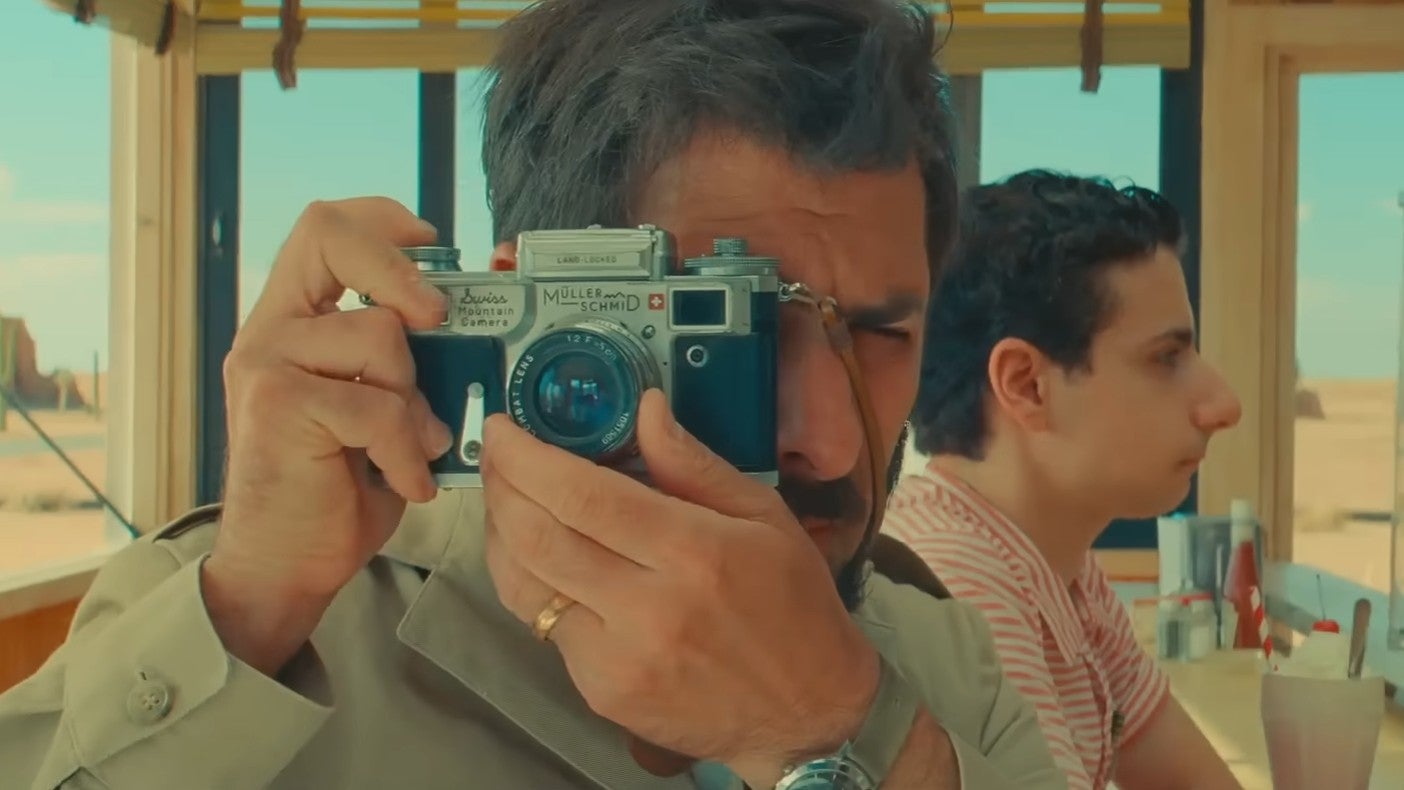
The scene in particular feels very minor in the grand scheme of the film, but I think it captures everything Anderson is trying to say about art and creation and expression. It all stems from the playfulness, vulnerability, and blissfulness of the children. Before the song, a couple of the kids interrupt June with different artworks that depict the alien. At this point, everyone has a million questions regarding their joint extraterrestrial sighting. Rather than suppress those thoughts because they might be too challenging or even unanswerable, the kids resort to artistic expression. Why? It doesn’t really matter. Dwight performs his song. June and Dakota eventually start dancing because they don’t know what else to do, but they feel the need to do something. A similar quick scene happens between Augie, Stanley (Hanks), and Woodrow (Ryan) where Woodrow asks a bunch of existential questions about their current circumstance, ending it with a sort of accusation directed at his father, stating, “You took his picture, dad.” Augie replies like he had a couple times before with a dry, “I’m a photographer.” I don’t think this response is as dismissive as it seems. I think it’s Augie’s way of expressing thoughts that don’t make much sense to him. He doesn’t know why he takes pictures of things. It’s just the outlet he deems most fitting to release his uncertainty.
Asteroid City, set in a classic retro-futuristic setting of a desert town not far from nuclear testing sites with themes to match. It goes without saying that the look of this movie is spectacular. It might be my favorite from Anderson across his entire discography. With hints of science fiction and a whole lot of meta movie structure hopping back and forth between the seemingly real life Asteroid City and the backstory and background of the theatrical performance that it originated from, Anderson’s newest work falls more in the realm of a current movement in art and media coined metamodernism. I don’t know too much about it, so there’s no need to extend this already long-winded piece with content coming from a guy who doesn’t fully know what he’s talking about. Instead, I’ll just compare the movie’s themes to those of other instances of art I enjoy.
Both of these examples recently gained traction on TikTok. I know because I spend too much of my time on said app. To avoid hypocrisy, I’ll admit that I have found lots of enriching material from social media. It’s filled with mindless garbage the majority of the time, but small nuggets here and there keep me hooked. I digress, however.
One of my other best friends, Ford, introduced me to the band Pinegrove back in high school. A song I’ve enjoyed, but never really gravitated toward before, blew up on TikTok recently. “Need 2” was originally released in 2014. It became the seventh track on the band’s 2015 debut Everything So Far. I think I’ve listened to the song at least a hundred times in the past month. Its lyrics are only a verse and a chorus, short and sweet. To start, the dejected narrator states, “I’m out/There’s nothing here to care about.” But an inner pull elicits curiosity and conflict. “What’s that sound?/What’s that song about?/It’s nothing worth me sayin’ aloud.” A twice-repeated chorus ends the first half of the three-minute song: “So then why do I seem to/Need to?” A raspy, airy instrumental then concludes the tune and it fades away. There’s not much in the form of immediate conclusions from this song. It’s messy and harsh guitar pattern and the off-kilter, classic Evan Stephens Hall-lead vocals make for a rather imperfect song. The beauty is that it can’t exist in all its sincerity in any other way. The product is as uncertain as the process it took to create it. There’s no purpose behind the piece besides the desire to create it. That’s all it needs.
Emotions are messy and confusing and so is meaningful art. It’s unapologetic and true. Augie takes his pictures because he feels the need 2. The kids make their art for the alien because they feel the need 2. June and Dakota dance to Dwight’s song because they feel the need 2. Wes Anderson makes movies the way he does because he feels the need 2. He just does so in a cleverly roundabout way. He knows people aren’t as perfect or eloquent as he makes his movies look. He edits with precision, he shoots with perfect symmetry, and he creates gorgeously-fake settings. All of these “perfect” aspects are used to unexpectedly hit audiences right in the gut with a blip of raw human emotion or connection or wonder. It stands out because it’s messy. But messy can be perfect if it’s done with passion.
I think we’ve been like this forever. The other TikTok example comes from Tarek Zaher. He made a video I originally liked in August of 2021 (original video). I came across it on Twitter again recently. His explanation far surpasses my truncated analysis to come, so definitely watch his video too. He breaks down the history of cave paintings and its discoveries over the years. Explorers found paintings of strange animals that looked mythical. Elephants with two trunks. Antelope with two heads. This sparked tons of conspiracy revolving around its religious or spiritual significance. That was until 1993 where a German scholar visited a poorly-funded cave in southern France without artificial lighting. Along with a local farmer and a lantern, the man noticed something new about these otherwise typical ancient paintings. Consistent with the flickering firelight from the lantern, the animals would move. The antelope with two heads now appeared as a normal one actively looking up and down. The elephant with two trunks became a normal elephant swinging his trunk back and forth. These ancient people painted these animals with the purpose to animate them. The scholar recognized that, “In short, [he] was watching a movie.”
The purpose of this endeavor from these ancient humans will probably never be clear. It very well could’ve been a commercialized commodity (but I doubt it). It also could’ve been a way to document experiences and relive them, similarly to June’s students’ drawings or Augie’s photographs. I think it shows that art can be simple and authentic at the same time. It doesn’t have to be profound. It can simply exist as an outlet, as a way to express or engage. Zaher says there’s something beautiful about knowing that “ancient humans descended into the depths to watch movies,” and I totally agree.
Back to procrastination, I have a hard time starting things. I have thoughts and ideas in my mind that I want to express, but I’m afraid that they won’t come out exactly as they appear in my mind. I’m afraid my pictures won’t all come out. But what I have to realize is that they’ll never come out if I never click the shutter. Augie bursts into tears in the scene read by his wife (Robbie) before taking a picture of her. That’s how he expresses himself. His pictures all come out because he takes them himself. I think that’s why Woodrow carries around the balcony picture of his mom and shows it to Dinah (Edwards) when she asks what she was like. It’s an authentic, artistic representation of her because it originated from a place of love and a desire to express that emotion.
While Augie might not fully struggle with this, his actor, Jones, leaves the stage and rushes to the director of the play, Schubert Green (Brody), in the hectic climax to call into question every emotion he’s feeling because he can’t pinpoint its greater purpose. Schubert reveals that it doesn’t matter as long as he just keeps telling the story and feeling it, even in all of its confusion and frustration. This all comes to a head with the subsequent scene, which I think would have been Christian’s favorite (again, he loved Margot Robbie). The actress that played Augie’s wife (Robbie) single-handedly recounts their scene together, which I mentioned Jones recited to playwright Conrad Earp (Norton) in the first act. In the second instance, Jones finally understands why his character is so certain that all of his pictures come out. The climax surges on strangely with the cast chanting, “you can’t wake up if you don’t fall asleep.” The end credits finally roll with both Jarvis Cocker’s fitting song of the same name right after Elizabeth Cotton’s hauntingly content “Freight Train.” Each of these final scenes point towards an acceptance of uncertainty coupled with a deep and inspired decision to push forward. Not acting in spite of life’s ultimate and unavoidable end but maybe I think even for the sake of it.
Christian lived each day for the sake of death. He loved with all of his heart for the sake of heartbreak. Now, in this crushing absurdity of a time, maybe I think he would want me and everyone he loved to just keep that freight train rolling down the track. We don’t need to know what train we’re on or what route we’re going. We just have to catch the ride.
Maybe I think Christian is up there in the stars. I can’t say for certain. I don’t need to. As long as sometimes I sometimes hear his voice singing a song he loved when I listen to it. As long as sometimes I sometimes see his fingerprints in the rings of a tree. As long as sometimes I sometimes feel his presence in the warmth of a sunny summer day. That’s good enough for me.
Augie’s pictures all come out because they are a part of who he is. I need to take more pictures because I know Christian is a part of every one of mine. And that means they will all come out.
Be First to Comment